
Gastronomy
15 PDO/AOC labels mountain cheeses
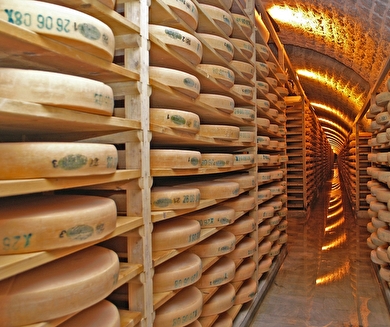
Mountains mean cheeses! From Beaufort and Comté to Gruyère and Ossau Iraty, we’ve put together a glossary of mountain specialities.
“A country that produces 365 kinds of cheese is ungovernable”, said Charles de Gaulle. Proof, if proof were needed, of the importance of this dairy speciality in French culture. In the mountains, where arable land is scarce, it has taken on unrivalled importance, to the point where it has become a flagship product of high-altitude gastronomy. Today, our Michelin-starred chefs serve it as is, hot or cold, as a starter or main course, and even with sweet dishes. Here’s a little reminder, or a conversation piece between pear and cheese, and we’ll tell you all about this French speciality: cheese and, what’s more, AOC mountain cheese.
Goat’s milk cheeses
Southern Alps
Le Banon – AOC 2003
This small goat’s cheese, wrapped in a chestnut leaf, weighs no more than 100g. Its supple to dry texture makes it a worthy representative of the Alpes de Haute Provence. Jean Giono, Frédéric Mistral and even Jules Verne have all mentioned it. But the most fervent fan was undoubtedly the Roman emperor Antoninus the Pious, who died of indigestion from eating too much!
Northern Alps
Chevrotin de Savoie – AOC 2002 – PDO
Chevrotin is a smooth, mild and aromatic uncooked pressed cheese. Made exclusively by hand, with no possibility of mixing milk, it is made using the same production technology as Reblochon, making it a highly original cheese for a goat’s cheese. Its casein tablet bearing the producer’s name ensures product traceability.
Sheep’s milk cheese
Pyrenees
Ossau Iraty – AOC 1980 PDO
Ossau comes from the name of the valley of the same name, Iraty means beech forest. This cheese from the Basque country has a well-balanced hazelnut flavour and a scent of flowers and fruit. On the palate, the cheese is dry and salty at first, before developing a tangy, sweet flavour. As the cheese ages, it is eaten with Morello cherry jam. Depending on the cheese, the maturing period varies from 12 to 17 months.
Cow’s milk cheese
Jura
Mont d’Or or Vacherin du Haut Doubs – AOC 1981 – PDO
Originally, this cheese was made when there was not enough milk to produce the large Comté cheeses. Appreciated by Jean Jacques Rousseau, it always had a place on the table of Louis XV, who loved its taste. To qualify for the AOC label, Vacherin cheese must be made between 15 August and 31 March, wrapped in a spruce strap and sold in a box of the same wood. It cannot be sold before 10 September, as it is the last seasonal cheese in France.
Vosges
Munster Géromé – AOC 1969 – PDO
Invented by Benedictine monks in the 7th century, it obtains its colour after rubbing with warm water from the Vosges. Géromé comes from the town where the cheese was sold. Its sharp, tangy flavour, creamy texture and distinctive aroma give it a distinctive personality.
Northern Alps
Reblochon de Savoie – AOC 1958 – PDO
Reblochon de Savoie is produced in… Haute Savoie! Its name, Rebloche, first appeared in the 13th century and comes from a fraud practised by farmers to avoid paying too much rent. The second milking was thus evaded from the general farmers. This much richer milk was better suited to cheese production. There are two types of Reblochon: farmhouse Reblochon has a green label and is made with milk from a single farm, just after milking. Dairy Reblochon is made in a cheese dairy with milk from several farms, and has a red label.
Cantal
Salers PDO
The origins of this pressed, uncooked cheese go back to the time when the herds spent the spring and autumn in the summer pastures. The milk is produced and, while still warm, immediately processed on the farm. The milk is not refrigerated or reheated. The cheese is only made between 15 April and 15 November, when the cows are grazing the meadows. The milk must be collected in a wooden container called a gèrlo. The milk is then loaded with bacteriological flora living in the wood of the gèrlo. This particularity is also a determining factor in obtaining specific tastes. As Salers is a farmhouse cheese, each farmer-cheesemaker produces cheeses with specific flavours.
Auvergne
Saint-Nectaire PDO
The first farmhouse PDO made from cow’s milk in Europe, Saint-Nectaire is produced in one of the smallest production areas, located exclusively in the mountains of the Puy-de-Dôme and Cantal départements, in the heart of the Parc naturel régional des Volcans d’Auvergne.
Northern Alps
Abondance PDO 1990
It was the canons of the Abondance monastery who selected a breed of cow, the “Abondance”, which had been introduced to the region by the Burgundians. They gave birth to this delicious cheese. Abondance soon found its way to the finest tables of the Savoy Court, and even to those of the Pope when he was elected in Avignon in 1381. You can recognise Abondance by its concave heel and its beautiful amber colour.
Northern Alps
Beaufort – AOC 1968 PDO
There isn’t just one Beaufort, but many! Simple Beaufort is made from the milk of cows brought down for the winter and fed on hay. Summer Beaufort is made, from June to October, from milk from the mountain pastures, with its pronounced aromas. Beaufort Chalet d’Alpage is the rarest. Only 400 tonnes are produced each year, over 100 days, from June to October. The milk used to make it must come exclusively from Tarine and Abondance cows, whose production must not exceed 5,000 litres per cow per year. Good to know: Beaufort cheese is at its best between 7 and 12 months.
Jura
Comté – AOC 1952 – PDO
Comté is sometimes called Gruyère de Comté. To obtain the designation, the milk must come exclusively from the Montbéliarde breed, and the cheese must be matured for at least 4 months. The best Comté has matured for at least a year. It is a highly aromatic cheese that becomes stronger with age.
Jura
Gruyère – AOC 2007
This is one of France’s oldest cheeses, made as far back as the 13th century in the Jura mountains between France and Switzerland. A world-famous cheese, Gruyère can be recognised by its small number of holes, no bigger than a cherry. It has a soft, melt-in-the-mouth texture and a fruity taste.
Northern Alps
Tome des Bauges – AOC 2002 PDO
Made in Savoie and Haute Savoie, Tome (with just one M) was made from milk that had been “creamed” to make butter. It was the staple of the peasant diet, “the one eaten by the peasant” and “which one could not do without at every meal” wrote Prefect Barante in 1807. One of the special features of Tome des Bauges cheese is that it is made in two ways: on the farm and in the dairy. Its cracked rind, particularly fruity flavour and cellar aroma give it a full-bodied flavour on the palate.
Life in blue
Jura
Bleu de Gex or Bleu de Septmoncel – AOC 1935 – PDO
This cheese, a favourite of Charles V, was the first national AOC cheese. Its blue-veined paste, made from cow’s milk, has a fairly mild flavour for a blue cheese, punctuated by hazelnut and mushroom aromas. The dairy cows are fed a diet based on grazed grass and hay, excluding all forms of fermented feed. Here’s how to recognise it: the word “Gex” must be moulded into the cheese during production.
Vercors
Bleu du Vercors Sassenage AOC 1998 – PDO
The origins of Bleu du Vercors Sassenage go back to the Middle Ages. The terrain and climate of the Vercors meant that the milk could not be transported. So farmers turned it into cheese. Diderot, who wrote about it in his encyclopaedia, was captivated by its light, damp hay aroma and mild, subtle flavour. This cheese is perfect for spicing up a sauce and, a less well-known recipe, can be used for an original raclette.
Focus