
White Mountain
Learn to ski
Skiing, the number one winter activity in the mountains, can be enjoyed by all ages and is accessible to everyone. But to get the most out of it and enjoy the thrill of skiing, it’s important to learn. Why and how should you learn to ski? What are the best tips for getting started? Follow the guide.
Why learn to ski?
The first aim of learning to ski is to master the techniques involved in skiing and snowboarding, and so gain the confidence to make the most of your time on the slopes. But you’ll also be taught the right behaviours to adopt to avoid injury as far as possible.
Learning to ski with an esf instructor, a qualified sports educator, also teaches you the rules of safety and good behaviour that apply in ski areas.
For a successful learning experience, trust the esf!
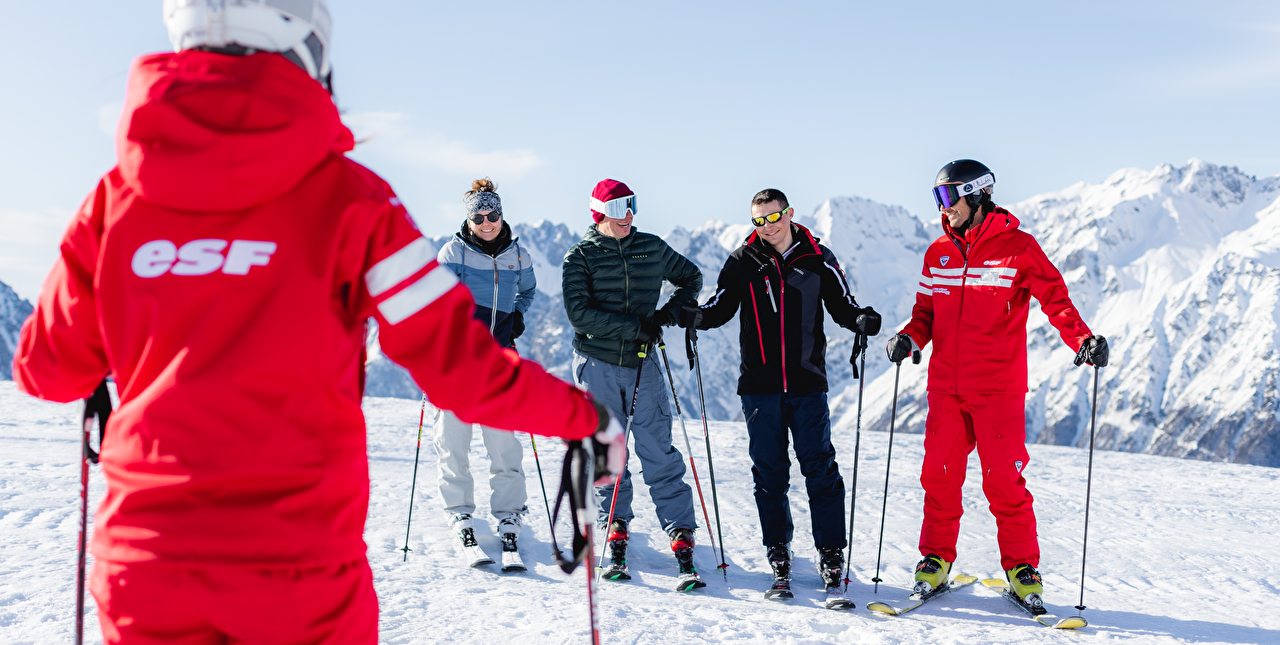
For 80 years, the Ecole du Ski Français (ESF) has been the pioneering ski school in France. With 220 schools and more than 16,500 instructors spread across all the country’s mountain ranges, the ESF offers you the guarantee of quality instruction, whatever your age, level, needs or expectations.
How do I know my level?
From children aged 3 and over to adults, the esf can assess your level using tests based on technical criteria. The instructor will then assess what you have learnt and where you need to improve.
People sometimes think that ESF instructors only teach children to ski, but everyone is welcome at the French ski school, even if you’re putting on skis for the first time at the age of 50!
How do I book a ski lesson?
For a great holiday on the slopes, think ski lessons with the esf! These days, it’s very easy to book a lesson at any ski resort in France.
Here’s how to book:
- From your resort’s esf website.
- If you’re already there, your esf school will welcome you to book a lesson and advise you on learning to ski. However, the best thing to do is to plan ahead and book your lessons in advance of your stay!
- Tip: to book several services in one basket (ski lessons, accommodation, equipment, lift passes and travel), go to the Mon Séjour en Montagne platform!
You can also download the myESF mobile application, which is quick and easy to use, so you can check your lesson cards anywhere, anytime!
Esf stars and levels
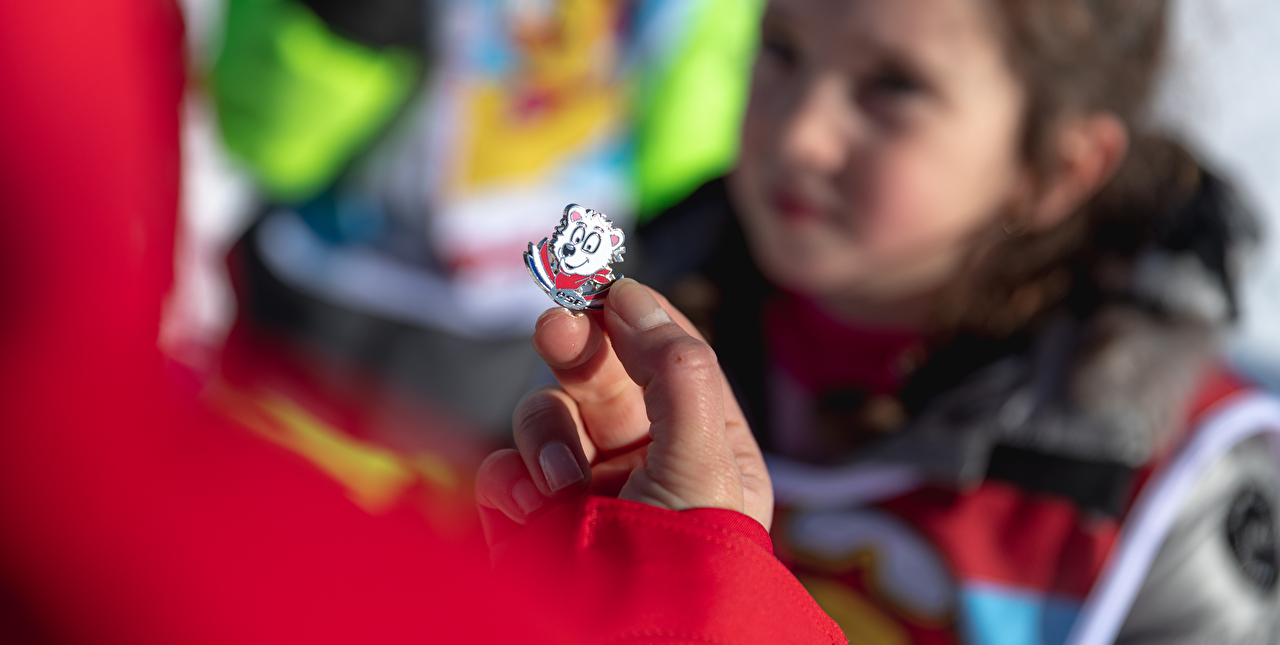
When a child learns to ski, it’s a real source of pride to get their first medals and stars from their esf instructor! There are no fewer than 12 levels of medals, from Piou-Piou to competition:
Piou-Piou:
With Piou-Piou, I discover the snow:
- I get around in the snow, on foot or on skis.
- And just like the grown-ups, I learn to put my skis on and take them off by myself!
- Snowmen, sledging, taking my first steps on skis – I’m discovering all my little skier’s equipment!
Blanchot:
With Blanchot, I make my first slides:
- I can recognise my skiing equipment.
- I move around on flat ground and slide down the slope.
Sifflote:
With Sifflote, I can slide and control my speed:
- I’m learning to plough down the slope with my skis.
- I’m using my first ski lifts.
Garolou:
I can change direction to avoid Garolou:
- I put on and take off my skis by myself.
- With my skis, I learn to make snowplough turns, to the left and to the right. That way, I can avoid Garolou’s lair on the way!
Ourson:
Are you 4 years old and already skiing at Club Piou-Piou, or are you just discovering skiing? With the “Ourson” level, you’ll be entering the big league!
Like Titourson, it’ll be super easy for you to :
- Put on and take off your skis by yourself.
- Use your first ski lifts.
- Control your speed by making turns that mimic the movement of a snake.
- Move around on your skis in different ways, on different types of almost flat terrain.
- Glide with your skis parallel, facing the slope, and stop with a snowplough turn.
- Be independent and able to ski outside the Piou-Piou club.
Flocon:
You’ve already got your “Ourson” medal in your pocket. Now you can try to reach the “Flocon” level.
Your first tasks:
- Control your speed, brake and stop.
- Go down a slope in a more or less straight line.
- And also, start skidding!
1st star:
You’ll learn to improve your balance, link turns and even do your first skids!
Here are your tasks:
- Slide down light to medium slopes and keep your balance.
- Go straight down a gentle slope and take small steps to turn.
- Make a number of simple turns while skidding (rounded or at an angle), and of course paying attention to what’s going on around you (other skiers, the relief of the piste, etc.)!
2nd star:
You’re now going to learn how to get over bumps, hollows and turns. With a bit of practice, you’ll win your 2nd Star!
Here are your tasks:
- Go over hollows or bumps, facing the slope or across it, while keeping your balance.
- Do the skater’s step, i.e. move forward on a flat track by pushing on your left leg and then on your right leg.
- Link about ten turns on a medium slope, with your skis parallel, paying attention to what’s going on around you (other skiers, the relief of the slope, etc.)!
- Know how to take turns with a rounded sideslip.
3rd Star:
With your 3rd Star, you’ll start to feel great sensations on the snow. Mastering turns and going full speed ahead is the basis for great skiing adventures!
Here are your tasks:
- Link up a series of more or less tight turns between poles, with your skis parallel, paying attention to what’s going on around you (other skiers, the relief of the piste, etc.).
- Control your balance while schussing (i.e. going straight down the slope) on different types of terrain: moguls, hollows, etc.
- Gaining speed and then skidding to a halt.
- Perform festoons: this is a succession of side-slips, interspersed with descents in a direct line.
Bronze Star:
With the Bronze Star, you can feel at ease on all types of snow.
Here are your tasks:
- Link up a series of tight turns quickly, changing pace as you go, on a course with 15 to 20 gates.
- On a piste or on a skiercross-type terrain, keep your balance when you’re in a schuss (i.e. going straight down the slope) then take off over light bumps.
- Learn how to do sculling turns (short turns using your poles), paying attention to what’s going on around you: other skiers, the relief of the slope, etc.
- Explore different types of snow.
Silver Star:
With the Silver Star, you can feel at ease on all types of snow. And the Gold Star is just around the corner. So get your skis on, you’re about to embark on your first real ski course.
Here are your tasks:
- To skid less and less and become more precise in your long trajectories.
- Enter the competition category and set your first time.
- Perfect your support and style to refine your sculling.
- Perform your first simple jump figures.
Gold star:
You’ll be able to ski downhill in all its forms. Before that, you’ll head to the top of the slopes for a real timed run. Ready for the competition?
Here are your tasks:
- Ski without stopping on fairly steep slopes and on all types of snow, paying attention to what’s going on around you: other skiers, the relief of the slope, etc.
- Be able to manage on prepared terrain: skiercross or half-pipe.
- Link up turns and sculls on a variety of terrain (different types of snow, different slopes with varying gradients).
- Complete a timed giant mini-slalom.
Progress… in stages!
Even if you want to hit the slopes and feel the adrenalin rush from the start, it’s important to take it one step at a time. The good news is that, with a bit of practice, you can progress quite quickly.
In all the resorts’ ski areas, the slopes are classified according to their difficulty, by colour.
The green and then blue runs are ideal learning areas. The gentle slope and the width of the piste mean that you can anticipate turns as much as possible. Many beginners try their hand at downhill skiing on these runs, but experienced skiers also use them to get to the bottom of the resort.
If you’re a beginner, don’t worry, it’s up to the skiers ahead of you on the piste to anticipate their trajectory in relation to yours. All you have to do is make sure you don’t park in the middle of the piste, so as not to get in the way of the other skiers.
Once you’ve mastered the turns on green and blue runs, and the technique is starting to sink in, you can move on to red runs. With a steeper slope, this time you learn to manage your speed. A word of warning to the more adventurous: don’t venture onto the black runs unless you can really control your movements and speed. Skiing is a pleasure, not a competition!
A few tips to get you started
- Choosing the right resort
Many resorts have facilities specially designed for beginners, such as learning zones, a wide variety of green and blue runs, adapted infrastructures and so on.
- Focus on safety
When you’re a beginner (and even afterwards), helmets are highly recommended! It’s important to have good quality equipment, so don’t hesitate to ask the resort’s professionals for advice when hiring skis, boots and other equipment. It’s also essential to pay attention to the safety rules on the slopes, so that you can cohabit with other users of the ski area.
- Preparing physically
When you’re not used to skiing, aches and pains come very quickly. A short warm-up is recommended to prepare the body for a particular and unusual physical effort. It also helps you avoid injury, control your effort and manage your fatigue.