

Sports and adventure
Cani-rando: a dogged walk
A hike in which you are harnessed to a dog – that’s the principle of the cani-rando. Many service providers offer this activity in French resorts. It’s ideal for getting children interested in hiking, and gives adults the chance to venture out onto new paths.
What is cani-rando?
In practical terms, cani-rando is practised with a large belt around the waist, connected to the dog’s harness by an elastic lanyard with a shock absorber.
For the less athletic among you, don’t worry: the cani-rando is not a race. “We walk at the pace of the human, not the dog.
We generally give him two commands: Ok, dogs! to start, and Oh! or Slow! to slow him down. In the latter case, it’s a good idea to lean back at the same time to pull on the lead rope,” explains Fabrice Talvat.
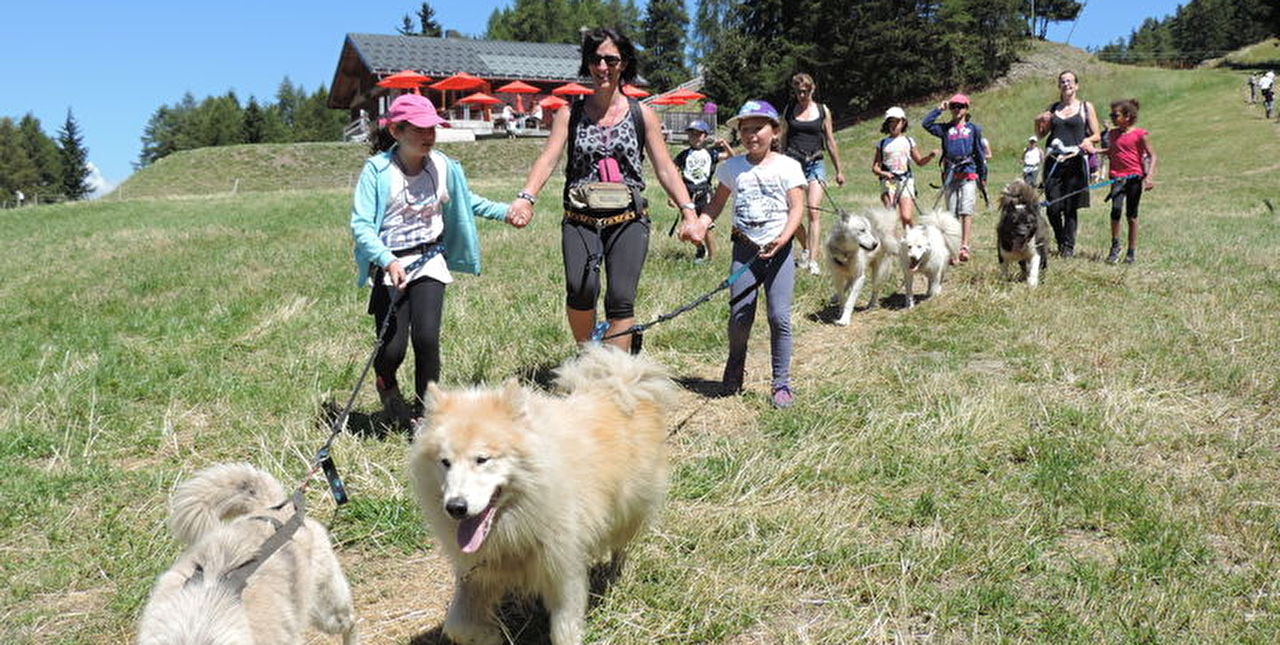
Cani-rando, for fun walks
“When will we get there?” What parent hasn’t heard this nagging refrain from their toddler during a walk in the mountains?
It’s true that the beauty of the landscape doesn’t have the same power of attraction over little ones as it does over adults. So cani-randoing is an excellent way of getting children involved in hiking, without putting them off. “Whether they like hiking or not, children are focused on their relationship with the dog”, notes Mathias Bernal, manager of Hors Trace Aventure, which offers cani-rando for children aged 8 to 17 in Plagne-Montalbert (Savoie).
Fabrice Talvat, a service provider based in Pierrefontaine-les-Varans, agrees, but adds that “it’s preferable for children to be able to walk for two hours”. Fabrice Talvat, like many of his colleagues, offers the activity to both adults and children.
The relationship with the dog is an essential part of cani-rando. For Mathias Bernal, the main attraction of this activity even lies in its educational dimension: “I use it as a pretext for dog training lessons for children. I teach them how dogs behave in a pack – the dominant/dominated relationship – and the basics of the musher’s job.
I also try to make them understand that you have to take responsibility for a dog in good times and bad, and that dogs don’t react to authority in the same way as humans do”.
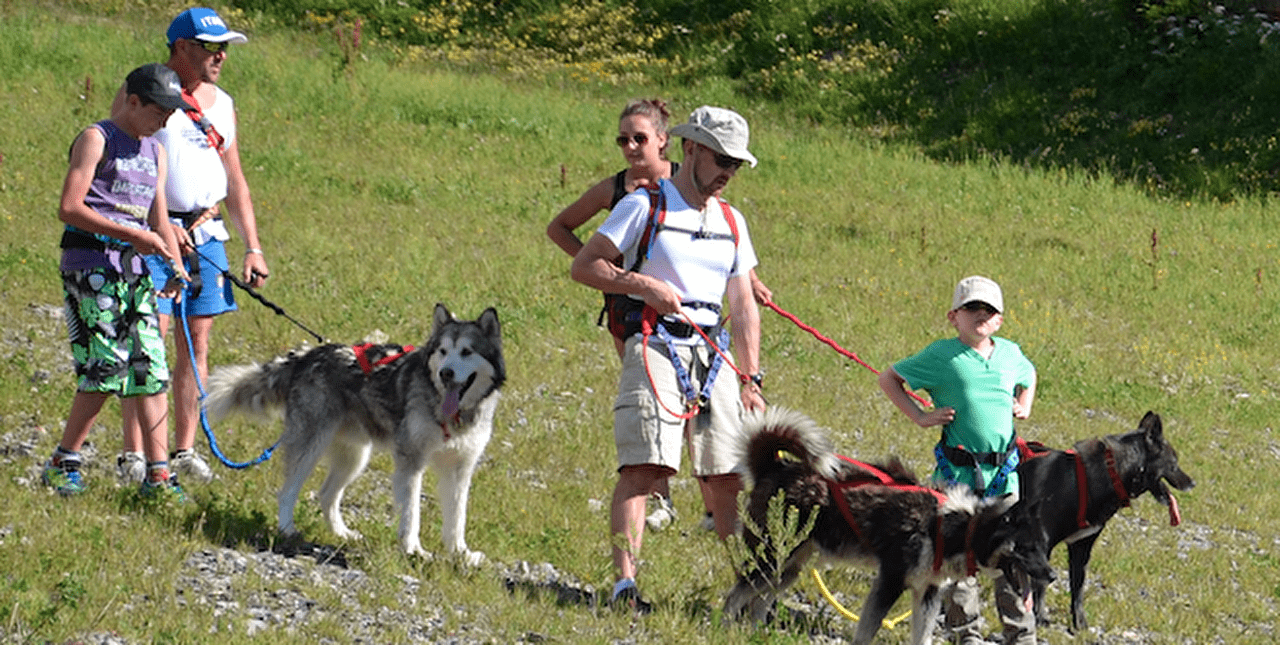
A sporting challenge: you can swallow the level without realising it
However, the sporting dimension has not been forgotten. “On climbs, the dogs provide a considerable help. I have many customers who tell me that they would never have tackled certain steep climbs on a traditional hike, but they climbed them without any trouble on a cani-rando”, says Fabrice Talvat.
It has to be said that the dogs used are often the same as those used to pull sledges in winter: Greenlanders, Huskies, etc. “They’re really powerful. “They’re really powerful. For children under 10, I use one dog for every two children. And I don’t use my malamutes, because they’re too powerful for this activity”, continues Fabrice Talvat, who is a musher in winter.
While the ascent is easier – you’ll climb steep slopes without even realising it – the descent is on the other hand more physical than a traditional hike: “You have to manage to slow the dogs down a bit. To do this, you walk like a duck, take small steps or bend your knees to lower your centre of gravity and get more grip on the ground.
Ideally, you should have done a long climb beforehand, so that the dogs are a bit tired and have less energy to spare”, concludes the manager of “Attelages de la Roche Percée”, in Pierrefontaine-les-Varans.