
Nature and landscapes
Mountain shelters
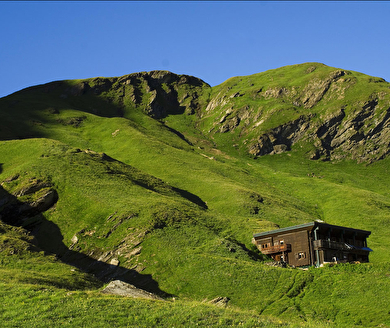
Looking for wide open spaces? Would you like to revive the myth of the great climbs of the last century? Or simply want to immerse yourself in the mountains? The refuge is for you! Far from the clichés of yesteryear, it has adapted to offer a real alternative accommodation option. Find out more.
Originally, a refuge was “a place where people retreat to escape danger or seek shelter”. They first appeared on the major mountain passes, for travellers crossing the Alps. France’s first mountain refuge was built in 1793 at Montenvers (at the mouth of the Mer de Glace), but most of them were built in the second half of the 19th century. At the time, they were usually rudimentary shelters, like shepherds’ huts, with communal sleeping accommodation.
Although their standards do not match those of “classic” hotels, today’s refuges are less and less like rustic, overcrowded accommodation.
While retaining their public service mission – the prices charged remain accessible to a wide public, to avoid any social discrimination – they take into account the increased demands for comfort from users, as well as environmental issues. Between 2000 and 2009, the Club Alpin Français renovated around twenty refuges to contribute to local mountain tourism policies.
The renovation of the Goûter refuge, the gateway to Mont Blanc, is a perfect example of how we have taken these modern challenges into account.
The new refuge, located 200 metres from the old one, is a High Environmental Quality (HEQ) building. Electricity is generated mainly by photovoltaic collectors on the façade and by a wind turbine, water from the toilets will be recycled, and a double-flow unit recovers heat from the extracted air to heat the new air by means of a rotary heat exchanger, etc.
These efforts to make the refuges more environmentally friendly and comfortable are not intended to turn them into luxury hotels. They will retain two essential components of their identity: accessibility, which is exclusively on foot (or skis in winter), and a certain conviviality between users, who exchange experiences and plans for climbs or hikes.
Saint-Gervais-Mont-Blanc, Haute-Savoie
Refuge du Goûter
France’s highest guarded refuge (3817 metres altitude). From 10 June to the end of September, this is the place to stop when climbing Mont Blanc. 100 places. Booking essential. More information on Les refuges du massif du Montblanc.fr
Saint-Etienne-de-Tinée, Alpes-Maritimes
Lac de Rabuons refuge
Situated at 2573 metres, on the edge of a three-hectare lake, on the Tour du Grand Cimon itinerary, this stone-walled refuge, guarded from mid-June to the end of September, has a capacity of 36 and offers catering services.
Saint-Sorlin d’Arves, Savoie
Etendard refuge
Overlooking the St Sorlin Glacier to the south and the Aiguilles de l’Argentière to the north, on the shores of the Grand Lac (or Lac Bramans), this refuge was renovated in 2007 and stands at an altitude of 2,430 metres, providing access to numerous family walks.
Saint-Maurice-sur-Moselle, Vosges
Plain du Canon refuge
This unguarded refuge is located slightly below the road leading from St Maurice to the Ballon d’Alsace, on the edge of a clearing in the national forest on the north-western slopes of the Ballon d’Alsace. An unexpected little prefabricated building, with electricity and drinking water, for hiking the GR 7 and GR 533.
Cauterets, Hautes-Pyrénées
Oulètes de Gaube refuge
From its completely renovated granite promontory (2151 m), the refuge offers one of the finest views of the Vignemale massif. You can admire the north face, Piton Carré, Aiguille des Glaciers and Chausenque. Access via the Gaube valley from the Pont d’Espagne. Sleeps 85, restaurant available.
Corrençon-en-Vercors, Isère
Hauts-Plateaux stopover gite
Ideal for hikers and cross-country skiers, this gîte is located at the gateway to the Vercors High Plateaux Nature Reserve, on the GR91. Completely renovated gîte, welcomes groups and individuals by the night.
Les Angles, Pyrénées-Orientales
Bouillouses refuge
Built at an altitude of 2005 metres, close to the Bouillouses lake, popular with fishermen, this refuge offers 59 beds, hot showers and a restaurant service. It is an ideal base camp for hiking, mountaineering, mountain biking, climbing and via ferrata.
Ristolas, Hautes-Alpes
Viso refuge
Set at 2,460 metres on a large plateau in a wide cirque of mountain pastures with numerous lakes, the Viso refuge is a favourite with mountaineers on their way to Mount Viso, the Pointe de Rome or the Pointe d’Udine. Renovated in 2002, it has a capacity of 65, with catering facilities.